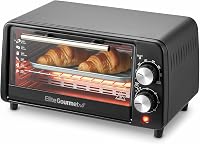
What Is a Convection Toaster Oven?
A convection toaster oven is a countertop oven with a fan that moves hot air around the food. That moving air helps food brown more evenly and can shorten cooking times, so check food a little early the first few times.
On this page (13 sections)
- Convection toaster oven: how the fan changes the cooking
- Convection vs a regular toaster oven
- What to change in a convection recipe
- Convection toaster ovens to consider
- How to tell if your toaster oven has convection
- Which foods gain the most from convection
- Pans that work with convection
- What the moving air does to food
- Using convection for reheating
- Common convection mistakes
- Quick checks for your first convection bake
- What to expect from the first few minutes
- Is a convection toaster oven worth it?
A convection toaster oven is a countertop oven with a fan that moves hot air around the food. What the fan changes is how evenly the heat reaches every side, which helps cookies, roasted vegetables and chicken brown more evenly.
Hamilton Beach says convection can cut cooking time by up to 25 percent, so check your own food early until you know how your oven behaves.
Convection toaster oven: how the fan changes the cooking
A regular toaster oven heats from the top and bottom elements and leaves the air still. A convection model adds a fan that pushes the hot air across the food, so heat reaches the sides and the top as well as the bottom.
Why a convection toaster oven moves heat differently
Still air forms a thin layer of cooler air around food. The fan breaks up that layer, which is why the outside of a cookie or a roasted potato browns faster in a convection model.
Convection vs a regular toaster oven
For toast alone, the two are close. The difference shows up when you bake, roast or reheat a larger amount of food, where convection tends to brown more evenly across the pan.
Many convection models also keep a plain bake setting. Use convection for cookies, roasts and vegetables, and use plain bake for delicate things like custard that can dry out or puff unevenly.
What to change in a convection recipe
Many recipes are written for a full oven, so start by checking the food early. The fan can brown food faster, so look at it a few minutes before the time on the recipe.
If the outside browns before the middle is done, lower the heat a little and give it more time. The manual for your model lists the settings that work best for it.
Convection toaster ovens to consider
These three models all have a convection setting, and each suits a different cook. They are a good starting point if you are choosing between convection models.
For a longer list, see the best convection toaster oven roundup.
How to tell if your toaster oven has convection
Look for a fan symbol on the control panel, a setting labeled convection or convection bake, or a fan grille on the back wall. The manual also states whether the model has a fan.
Some models run the fan only in the convection setting. Use that setting when you want faster, more even cooking.
Which foods gain the most from convection
Convection helps most with foods that need even browning on several sides. Roasted vegetables, cookies on one pan, chicken pieces and pizza crusts often come out more even.
Batters and custards tend to do better on a plain bake setting, since moving air can dry the top. Try both settings on a small batch before you make a big one.
Pans that work with convection
Pans with low sides let air move over the food, so a flat sheet or a shallow dish works best for roasting. A tall, deep pan can block the airflow and slow the cooking in the middle.
Keep the pan clear of the top element and leave room on every side. Black+Decker says to keep bakeware at least 1½ inches from the top heating elements on its TO1313SBD, which is a good rule to check against your own manual.
What the moving air does to food
The moving air dries the surface of food, so the outside turns crisp and golden. That's useful for roasted vegetables and reheated leftovers, and it can be a problem for soft cakes or custards.
Using convection for reheating
Many people use convection to reheat leftovers, since the fan crisps the outside without the soggy texture a microwave can leave. Spread the food in a single layer, and check it early, since small pieces heat fast.
Common convection mistakes
Crowding the rack blocks the airflow, so food steams instead of browning. Leave gaps between pieces so the air can reach every side.
Forgetting to adjust the time is the other common slip. Check the food early, since the fan can brown it faster than the recipe expects.
Quick checks for your first convection bake
- Preheat the oven fully before the food goes in.
- Set a timer for the shortest time in the recipe, then check early.
- Note the time and the setting that worked, so the next bake is easier.
- Rotate the pan halfway if the browning looks uneven.
What to expect from the first few minutes
A convection toaster oven usually heats faster than a full oven, because the space is small. Let it preheat fully before the food goes in, since a cold start changes the timing of the whole bake.
Is a convection toaster oven worth it?
Pick a convection model if you bake, roast or reheat often, since the fan gives more even results. For toast alone, a basic toaster oven is usually enough.
For what the numbers on the box mean, read toaster oven wattage. If you mostly bake, the guide to baking in a toaster oven covers pans and timing.
The air fryer toaster oven buying guide shows how convection fits with air frying.
Frequently asked questions
Is a convection toaster oven better than a regular toaster oven?
For baking, roasting and even browning, convection often does better because the fan keeps the heat moving. For toast alone, a regular model does the job with fewer settings.
Do you need to change the temperature for convection?
Some cooks lower the heat a little or cut the time, but the manual for your model is the best guide. Check food a few minutes early the first time you cook a recipe, since the fan can brown food faster than a plain oven does.
Is a convection toaster oven the same as a convection oven?
The fan works the same way, but a toaster oven holds less food and heats a smaller space. It sits on a counter, while a full convection oven is built into a wall or a range.